


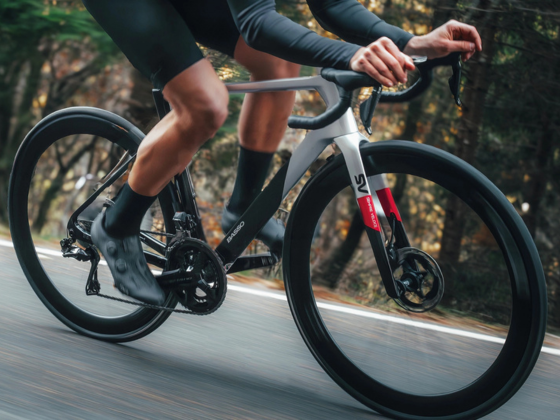
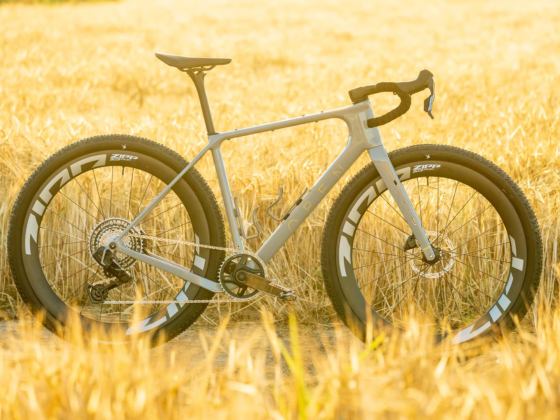


For decades, road cycling pursued narrower tires and higher pressures. The logic seemed simple: less rubber on the ground should mean less friction.
Today we know that interpretation was incomplete.
Modern bicycles are increasingly using 28, 29, or 30 mm tires, even at the highest competitive level. In many real-world conditions, a wider tire, properly installed and used at the correct pressure, can be more efficient, faster, and safer.
01 · Rolling Resistance
Less useless deformation
A fast and well-pressurized casing loses less energy.
02 · Vibration
More contact with the asphalt
Fewer bounces mean less wasted energy.
03 · Control
More grip and stability
Better support in corners, braking, and uneven roads.
04 · Aerodynamics
The wheel matters
A 30mm tire must integrate with the external rim width.
Evolution of the standard
From 23 to 30 mm
23
MILLIMETERS
Narrow rims, low volume, and very high pressures.
25
MILLIMETERS
First big change towards more grip and lower pressure.
28
MILLIMETERS
Current reference for competition and fast roads.
30
MILLIMETERS
More volume, less vibration, and a new performance benchmark.
Rolling resistance doesn't depend only on width
As the tire moves forward, it deforms when it comes into contact with the ground and regains its shape when it leaves the contact patch.
During this process, a small amount of energy is lost. This loss depends on the casing construction, compound, pressure, load, and the system used.
Therefore, it is not correct to state that a wide tire always rolls better. Nor that a narrow one is always faster.
The real equation
Flexibility and number of plies
Ability to deform without dissipating energy
Balance between support and absorption
Smooth, rough, or damaged asphalt
Key concept
What is hysteresis?
It is the energy that the tire fails to recover after deforming.
A portion of the energy applied to the casing is converted into heat. The more flexible and efficient the tire, the smaller this loss will be.
ENERGY INPUT
RECOVERED ENERGY
HEAT
The paradigm shift
Losses due to vibration
Asphalt is never perfectly smooth. When the pressure is too high, the wheel stops adapting to the terrain and starts to lift the bike and rider over every bump.
Pressure too high
The wheel bounces and transmits the irregularity to the bike-rider assembly.
Adequate pressure
The tire conforms to the terrain and maintains more constant contact.
Common mistake
Confusing a harsh feel with a faster bike. Perceived stiffness can come from vibrations that are consuming energy.
The efficient zone
Optimal pressure is between two errors
−
Too low
Excessive deformation, loss of support, and risk of rim impact.
✓
Optimal pressure
Balance between rolling resistance, absorption, grip, and stability.
+
Too high
More bounces, vibrations, and losses on imperfect surfaces.
What determines the correct pressure
Rider, bike, and equipment.
Not just the measurement written on the sidewall.
Internal and external width, and bead type.
The rougher it is, the lower the efficient pressure usually is.
The rear wheel usually needs slightly more pressure.
The system modifies the risk of pinch flats and behavior.
Dog Days Insight
Don't copy another rider's pressure. Two people with seemingly identical tires may need very different adjustments.
Contact with the ground
Wider doesn't simply mean "more friction"
For the same load and pressure, the approximate area of the contact patch mainly depends on the relationship between both variables.
Width mainly modifies the shape of the footprint. A narrow tire creates a longer patch; a wide tire creates a shorter and wider one.
NARROW TIRE
Long and narrow footprint
WIDE TIRE
Short and wide footprint
The limit of increasing width
Aerodynamics
The tire is the first part of the wheel that comes into contact with the air. To control the airflow, the tire and rim must function as a single system.
UNFAVORABLE COMBINATION
The tire bulges out from the rim, creating a light bulb-like shape.
OPTIMIZED COMBINATION
The outer rim width matches the tire profile.
Josh Poertner · SILCA · Zipp
The 105% rule
The maximum outer rim width should ideally be at least 105% of the actual tire width.
| Actual tire | Approximate outer rim | Calculation |
|---|---|---|
| 25 mm | 26.25 mm | 25 × 1.05 |
| 28 mm | 29.40 mm | 28 × 1.05 |
| 30 mm | 31.50 mm | 30 × 1.05 |
| 32 mm | 33.60 mm | 32 × 1.05 |
The rule refers to the actual width, not the nominal measurement written on the sidewall. Furthermore, it analyzes aerodynamics but does not, on its own, incorporate potential gains in rolling resistance and vibration reduction.
Aerodynamic cost measured by Zipp
−1 W
When switching from 28 to 30 mm in the configuration tested by the brand.
Gain in rolling resistance and vibrations
+6 W
Result reported by Zipp in their roller test with a road-like surface.
Important: these data correspond to a specific Zipp configuration. They should not be automatically extrapolated to any wheel, tire, or speed.
The measurement that really matters
A 29 mm tire can end up measuring 31 mm
The internal rim width modifies the shape, volume, and final measurement of the tire.
ENVE indicates, for example, that their 29 mm SES tire measures approximately:
WorldTour
What do professionals use?
The professional peloton has largely abandoned the old 23 mm standard. Currently, 28, 29, and 30 mm sizes are common, usually with tubeless setups and pressures adapted to each rider, wheel, and route.
In February 2026, Vittoria presented a 30 mm version of the Corsa PRO Speed developed, according to the brand, at the request of WorldTour teams.
28 mm vs 30 mm
28
MILLIMETERS
Choose 28 mm when:
- The wheel is optimized for this size.
- You seek maximum aerodynamic integration.
- You compete on good quality asphalt.
- The tire already measures close to 29 or 30 mm.
- The frame has limited tire clearance.
30
MILLIMETERS
Choose 30 mm when:
- You ride on rough or uneven asphalt.
- You go on long rides or gran fondos.
- You seek more grip and confidence.
- The wheel is designed for wide tires.
- You want to reduce pressure and vibrations.
Mixed setup
28 mm front and 30 mm rear
28 mm
Aerodynamics and steering
30 mm
Load, traction and absorption
This can be a good combination when the front wheel prioritizes aerodynamics and the rear wheel supports a greater proportion of the weight. Rim compatibility remains essential.
Myth vs reality
What we thought we knew
A narrow tire always rolls faster.
It depends on the casing, pressure, surface, and vibrations.
More pressure means less resistance.
Only until impedance losses begin to increase.
30 mm only serves to gain comfort.
It can also improve efficiency, grip, braking, and control.
The printed measurement is the actual measurement.
The internal rim width can change the final result.
Technical checklist
Before mounting 30 mm tires
For hookless systems, official compatibility and pressure charts from manufacturers must be strictly followed.
Conclusion
30 mm is not a fad
The growth in road tires is not solely due to a quest for comfort.
30 mm tires allow for lower pressure, absorb irregularities, reduce vibrations, and maintain more ground contact. Combined with a fast casing and a compatible wheel, they can offer superior performance on real roads.
The question is not whether 28 mm is better than 30 mm.
The question is which combination minimizes all losses on your actual terrain.
SEO FAQ
Frequently Asked Questions
Does a 30 mm tire roll slower than a 28 mm tire?
Not necessarily. On real asphalt, 30 mm tires can reduce vibration losses. The final result also depends on the casing, pressure, surface, and wheel aerodynamics.
Is a 30 mm tire less aerodynamic?
It may present a slightly larger frontal area, but the difference depends on its integration with the rim. A wheel designed around wide tires can maintain very efficient aerodynamic performance.
What pressure should I use with 30 mm tires?
It should be calculated based on total weight, actual size, rim, setup, and surface. There is no universal pressure valid for all cyclists.
Can I mount 30 mm tires on any bike?
No. You must check the frame and fork clearance, the actual tire width, and its compatibility with the rim.
Is it a good idea to mount 28 mm on the front and 30 mm on the rear?
It can be a good solution to combine front aerodynamic performance with greater volume, traction, and support on the rear wheel.
Do professionals use 30 mm tires?
Yes. Currently, 28, 29, and 30 mm sizes are common in professional cycling, chosen according to the rider, wheel, stage, and road surface quality.
Does a wide tire protect better against punctures?
Width is not the only factor. Construction, casing protection, pressure, tubeless system, and impact type all play a role.
References and sources
- Josh Poertner / SILCA: Tire Pressure and Aerodynamics.
- Zipp: 28mm vs 30mm Tire Comparison.
- Zipp: Tire size and the Rule of 105.
- ENVE: SES Tire Technical Specifications.
- Vittoria: Corsa PRO Speed 700x30c Launch.
- SILCA: Tire Pressure Calculator Explained.
- SILCA: Asymmetric Effects of Tire Pressure.